


Beatriz Milhazes has long been celebrated as one of Brazil’s most significant contemporary artists, her canvases bursting with ornament, rhythm, and chromatic intensity. Yet beneath the dazzling surface lies a methodology deeply entangled with questions of materiality, repetition, and reuse.
Since 1989, Milhazes has employed her singular monotransfer technique—painting on sheets of plastic, peeling them away, and applying the dried pigment to canvas. This indirect process, closer to collage than to conventional painting, allows her to recycle motifs across works, layering forms and patterns that carry traces of both rupture and continuity. The technique destabilises the hierarchy between “original” and “copy,” echoing postmodern debates around seriality and reproduction.
Her collages, particularly those gathered in Beatriz Milhazes: Colagens / Collages (2018), radicalise this recycling impulse. Candy wrappers, chocolate foils, printed papers, and fragments of packaging—objects destined for disposal—are meticulously assembled into shimmering compositions. In this gesture, Milhazes reframes the banal detritus of consumer culture as material for poetic re-enchantment, a strategy that resonates with Brazilian traditions of bricolage and anthropophagic cultural cannibalism.
Formally, her work navigates a dialogue between Western abstraction and the decorative lexicons of Brazil: baroque ornamentation, folk motifs, and carnival exuberance. Yet the act of recycling, both of materials and of cultural symbols, lends her practice a political resonance. Waste becomes beauty, repetition becomes transformation, and the periphery enters the global stage of contemporary art not through erasure, but through excess.
In a world increasingly anxious about ecological crisis and overproduction, Milhazes’s practice models an alternative logic: one of reuse, reinvention, and insistence that value can be found in the overlooked. Her work, therefore, is not only visually intoxicating but also conceptually urgent—an art of sustainability and survival disguised in flowers, spirals, and radiant geometries.
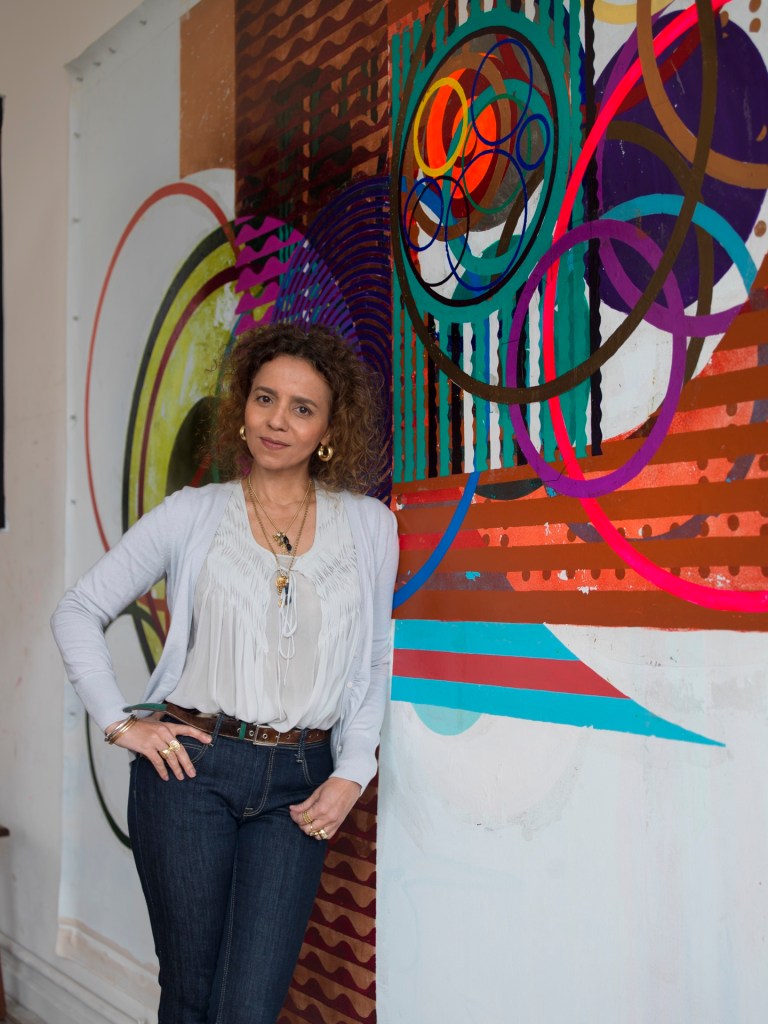
Beatriz Milhazes (b. 1960, Rio de Janeiro) is one of Brazil’s most prominent contemporary artists, known for her vibrant large-scale paintings, collages, and prints. After studying at the Escola de Artes Visuais do Parque Lage in Rio during the 1980s, she developed her signature monotransfer technique, transferring painted motifs from plastic sheets onto canvas to create layered, kaleidoscopic surfaces. Drawing on Brazilian baroque, folk art, and Carnival traditions while engaging in dialogue with Western abstraction, her work bridges cultural histories and visual languages. Milhazes has exhibited widely, including at the Fondation Beyeler, Tate St Ives, and the Guggenheim Museum, and her pieces are held in major collections worldwide, such as MoMA (New York), MASP (São Paulo), and Centre Pompidou (Paris).
Key academic / catalog references you can cite
- Beatriz Milhazes: Colagens / Collages. Ed. Frédéric Paul. Rio de Janeiro: Cobogó, 2018.
- Beatriz Milhazes: Avenida Paulista. São Paulo: MASP & Itaú Cultural, 2021.
- Beatriz Milhazes. Fondation Beyeler / Hatje Cantz, 2012.
- Guggenheim Museum. “Collection in Focus: Beatriz Milhazes—Rigor and Beauty.”
- Tate St Ives. Maresias exhibition texts.
 Rupture Magazine
Leave a comment