


Art doesn’t require fine materials or to follow trends. For Arthur Bispo do Rosário (1911–1989), creation came straight from the heart: a living, breathing act that made his mind free.
A Simple Mission, a Monumental World
In late December 1938, Bispo experienced a vision: angels descending on Rio de Janeiro, commanding him to recreate the entire world for Judgment Day. He would spend over 50 years confined in Colônia Juliano Moreira, crafting a universe made of ordinary scraps, silently obeying that divine mandate .
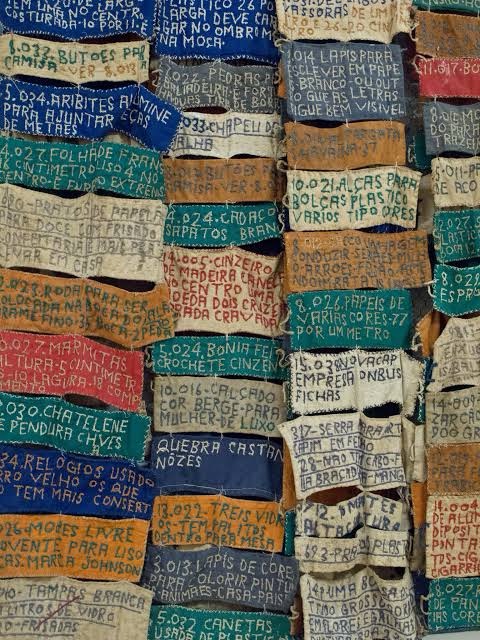
He did not use marble or canvas, but hospital uniforms for blue thread, old shoes, cups, bottles, cardboard and wood. Everything ordinary became sacred when he wrapped, embroidered, catalogued, and transformed it into a testimony of life and spirit .
A World Stitched from Memory
Using that blue thread, Bispo embroidered banners, garments, and the famous Presentation Mantle, meant to be worn before God. On its surface: everyday objects, abstract signs; inside: names of people he had met—creating a personal cosmos sewn from memory .
Every piece was a statement of presence: he counted, catalogued, and embodied existence—not for fashion, but because it mattered, deeply.
This was not art out of illness, nor therapy. Bispo never called himself an artist. He said simply: “The voices tell me to do this way” . The power lies in that honesty—the work is not sentimental; it’s real, raw, and direct.
He turned refusal into freedom. He wasn’t interested in galleries or trends. His cell became a studio; his material was what was around him. Through that intimacy with humble things, he made something grand.
Seen Now as a Giant, Then Just Doing
Bispo’s art defies pity. It defies labels like “outsider” or “naive,” even though critics later placed him within the art world. Academic voices question whether calling his work “contemporary art” replaces one kind of control (psychiatric) with another (formal aesthetic)—but his power remains, untouched by these debates .
In exhibitions—from MAM-Rio in the early 1980s to the Venice Biennale in 1995, and his global presence since—his creations demand an emotional response, not an analytical one .
A True Artist in Every Sense
Arthur Bispo do Rosário shows us that real art needs only sincerity and vision. It doesn’t ask for pity or applause—only attention. In every wrapped object and embroidered banner, we see someone declaring: “I exist. I remember. I speak.”
He refuses to be an oddity. He is a radical reminder: creation is the ultimate freedom.
Key Exhibitions of Arthur Bispo do Rosário
1. “À margem da vida”, Museu de Arte Moderna (MAM), Rio de Janeiro — 1982
This was Bispo’s first public exposure, during his lifetime—a group exhibition focusing on art emerging from margins of society. He did not attend in person, but carefully chose which works to show and how they were displayed .
2. Solo Exhibition at Escola de Artes Visuais do Parque Lage, Rio de Janeiro — October 1989
Curated by Frederico de Moraes, this was the first major solo presentation of his work—and the first to take place posthumously .
3. 46th Venice Biennale, representing Brazil — 1995
Bispo’s work gained international acclaim here, where he exhibited alongside Nuno Ramos in Brazil’s national pavilion, marking his formal entry onto the global art stage .
4. Mostra do Redescobrimento / Imagens do Inconsciente, Parque Ibirapuera, São Paulo — 2000
Bispo’s work featured in this show that explored hidden or under-explored aspects of art, alongside other “Inconsciente” themed works .
5. 55th Venice Biennale – “The Encyclopedic Palace”, Venice — 2013
Although not in Brazil’s pavilion, Bispo’s work appeared in this major thematic exhibition of the Biennale, highlighting his ongoing relevance .
6. “Bispo do Rosário: All Existing Materials on Earth”, Americas Society, New York — January–May 2023
This was his first-ever solo exhibition in the United States, bringing together more than a thousand objects, including the iconic Manto da Anunciação .
7. “Sonoridades de Bispo do Rosário”, Oscar Niemeyer Museum (MON), Curitiba — July 2023–February 2024
A powerful exhibition of over 100 works, putting Bispo’s legacy in dialogue with contemporary artists influenced by his practice
 Rupture Magazine
Leave a comment