
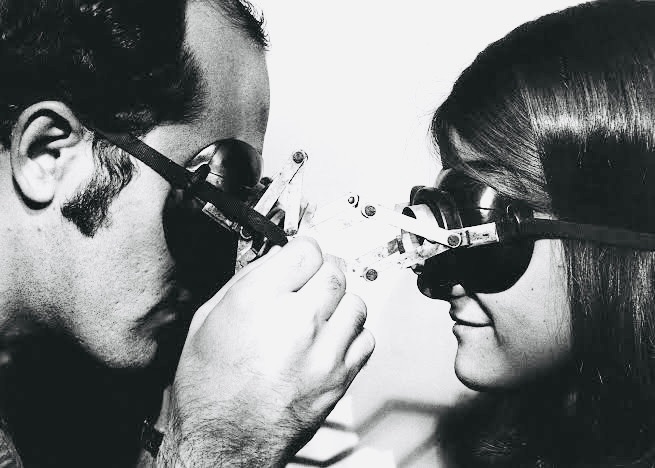


When the Brazilian artist Lygia Clark (1920–1988) cut open the picture plane, she also cut open the body of modernism. What had been an optical regime of form and color suddenly became tactile, relational, collective. Clark’s trajectory — from geometric abstraction to her radical “propositions” — is one of the most significant ruptures in twentieth-century art. She did not simply anticipate performance; she unsettled its very foundations, creating a space where art was no longer about the artist’s presence on stage, but about the participant’s embodied experience.
Breaking the Frame
Clark’s earliest works from the late 1940s echo the rigorous modernism of Picasso, Mondrian, and Klee. Yet her canvases already contained cracks in the grid. The “Modulated Surfaces” (1950s) pulled geometry into movement, suggesting the painting was never stable, always on the verge of becoming something else. Her alignment with Grupo Frente in Rio positioned her inside the avant-garde debates of the time, when Concretism promised order and rational clarity in a newly industrial Brazil.
But Clark — together with Hélio Oiticica, Lygia Pape, and Ferreira Gullar — refused the sterility of hard geometry. In 1959, she co-signed the Neo-Concrete Manifesto, declaring that art was not a machine but a “living organism.” This was not a metaphor. It was a demand: art must move, breathe, and implicate the body.
From Object to Experience
By the early 1960s, Clark was dismantling the art object. With her Bichos (Critters, 1960–63), hinged aluminum sculptures that could be folded and twisted, the artist no longer controlled form. The viewer’s manipulation created endless variations. The object was no longer autonomous; it only existed through action. In this sense, Clark destabilized authorship. She invited the participant to finish the work.
Then came the radical gesture of Caminhando (Walking, 1963): a Möbius strip of paper, cut continuously with scissors, in an infinite spiral. Clark called this a “proposition,” not a performance, not a spectacle. There was no audience, no stage. The art was the act of cutting, the intimate passage of hand and paper, the endless decision of where to go next.
Here Clark refused the terms of European and North American performance art, which often centered on the artist’s body as site of endurance, spectacle, or risk. For her, the body was plural. The proposition was relational, not representational.
The Collective Body
Exile in Paris during the late 1960s and 1970s intensified Clark’s turn to sensorial and collective practices. In works such as The Collective Body and Relational Objects, she designed simple tools — bags of air, stones, masks, shells — that participants placed on or against their bodies. The effect was visceral: breath, weight, touch, and texture produced a new consciousness of the self as porous, always in relation to others.
Clark described these experiments as “rituals without myth.” They were stripped of symbolic narrative, focused instead on sensation. And yet, in a Brazil marked by dictatorship and censorship, these experiments carried political urgency. To reclaim the senses, to experience the body not as an isolated machine but as part of a shared field, was itself a radical refusal of authoritarian control.
Toward the Therapeutic
By the 1970s and 1980s, Clark explicitly framed her propositions as therapeutic. She abandoned the museum for the clinic, developing methods of sensory therapy with psychiatric patients. The rupture was complete: art as object had dissolved into art as care, into art as a process of healing, intimacy, and vulnerability.
Some critics dismissed this as an abandonment of art. Others now see it as the ultimate consequence of her practice — an expansion of art beyond itself, into lived experience. What mattered was not aesthetic display but the transformation of perception, the possibility of reconnecting body and world.
Why Lygia Clark Matters
To understand Clark is to understand rupture. She ruptured the frame, ruptured the idea of authorship, ruptured the separation of art and life. She proposed a form of performance that refused to be called performance, a practice where the body was not staged but enacted, not displayed but shared.
Her work belongs to its moment — the ferment of Brazilian modernism, the trauma of dictatorship, the global search for new forms of embodiment — but it also escapes it. Today, when art again grapples with participation, collectivity, and care, Clark’s propositions remain urgent.
In the Möbius strip of Caminhando, there is no end. Just the spiral cut, the endless passage of body through matter, matter through body. That is Lygia Clark’s legacy: the proposition that art is always unfinished, always in the hands of those who touch it.
References
Brett, Guy. Experiments with Truth: Lygia Clark, Hélio Oiticica, and Brazilian Art of the 1960s. London: Whitechapel Gallery, 2004. Fabbrini, Ricardo Nascimento. “The Aesthetic of Rupture: Lygia Clark and the Neo-Concrete Movement.” Revista Pesquisa FAPESP, 2013. Lepecki, André. “Affective Geometry, Immanent Acts: Lygia Clark and Performance.” post: notes on art in a global context (MoMA), 2014. Pape, Lygia; Clark, Lygia; Oiticica, Hélio; and Ferreira Gullar. Neo-Concrete Manifesto. Rio de Janeiro, 1959. Rolnik, Suely. Lygia Clark: The Abandonment of Art. São Paulo: Pinacoteca de São Paulo, 1999. Tavares, Monica. “The Therapeutic Art of Lygia Clark.” Interartive Journal, 2012. Yúdice, George. “Lygia Clark and Hélio Oiticica: A Legacy of Interactivity and Participation for a Digital World.” Leonardo 30, no. 5 (1997): 387–390. Zanini, Walter. História Geral da Arte no Brasil. São Paulo: Instituto Moreira Salles, 1983.
 Rupture Magazine
Leave a comment