

Te Toi o te Ātetenga: The Art of Resistance
Rangimārie Sophie Jolley explores Te Toi o te Ātetenga: The Art of Resistance, to understand wāhine activist art as a platform to protest and highlight Tino Rangatiratanga.
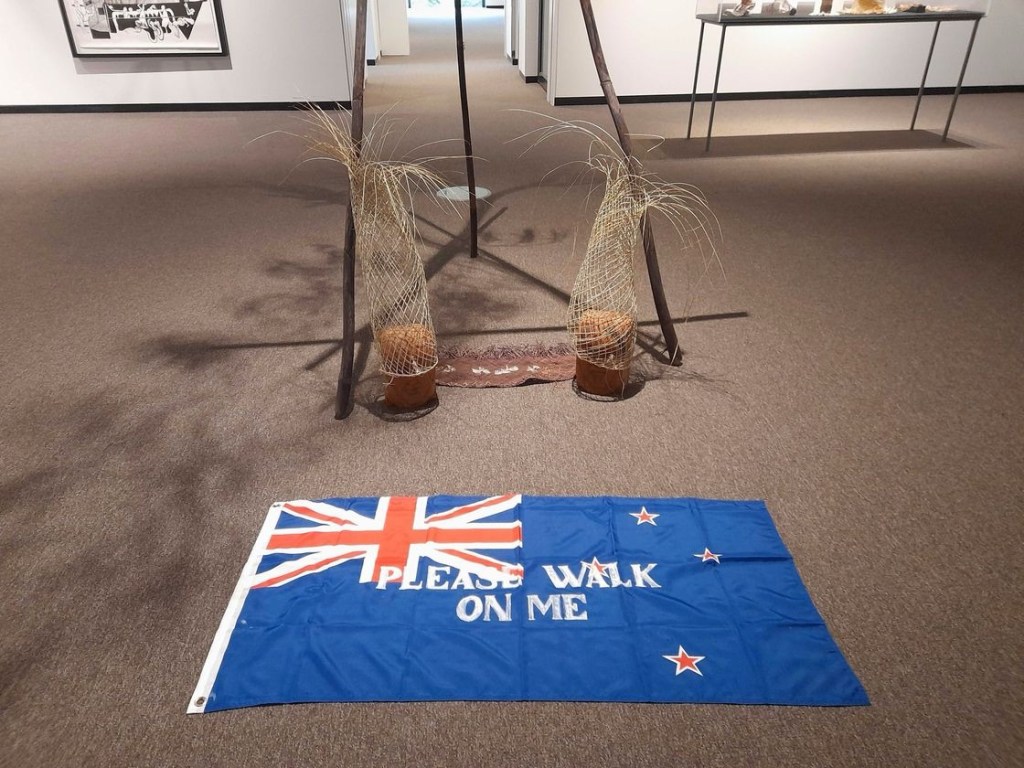
Artwork Flagging the Future by Māori artist Diane Prince has been removed from public display. (Image: AP PHOTO)
“Colonisation never really ended. It morphed into the systems we now live in.”
This statement from the lecture series Kaupapa That Connects Us echoes the conclusion of decades of Māori scholarship: racism is not about ignorance or misunderstanding. It is a deliberate design embedded in law, institutions, and governance structures. Research confirms that 93% of Māori report experiencing racism in their daily lives (Whakatika Survey, 2020). The consequences are not symbolic; they are measurable in health disparities, premature mortality, and persistent inequities in education and justice (Reid et al., 2019).
Calls for cultural sensitivity training or awareness campaigns have proven insufficient. As Linda Tuhiwai Smith argued in Decolonizing Methodologies (2012), colonisation has always been about control of knowledge and systems. What is needed is not tokenistic recognition but structural redesign grounded in Te Tiriti o Waitangi and Kaupapa Māori methodologies.
Structural Racism in Aotearoa
Racism in Aotearoa is systematic, layered, and institutional. The Ministry of Health’s Whiria te Muka Tangata (2020) framework describes racism across four domains:
Structural (kawa) – laws and policies privileging Pākehā systems; Institutional (tikanga) – biased practices in schools, hospitals, and courts; Interpersonal (ritenga) – everyday discrimination; Outcomes (putanga) – unequal health, income, and life expectancy.
Māori rangatahi carry these burdens most heavily. The R4A Project (2023) showed that racism undermines Māori youth identity, wellbeing, and health, confirming that racism is not a “past wound” but an ongoing injury.
Global Parallels of Colonisation
Aotearoa is not alone. The claim that racism is “a design” is echoed across Indigenous and colonised communities worldwide.
Australia
Aboriginal and Torres Strait Islander peoples experienced policies of forced assimilation, including the Stolen Generations. Research shows systemic racism across policing and health (Paradies, 2006). Like Aotearoa, symbolic recognition—such as “Acknowledgement of Country”—often functions as tokenism when not matched with structural change. Unlike New Zealand, Australia has never signed a treaty, leaving Indigenous sovereignty largely unrecognised.
Canada
Residential schools operated for over a century, forcibly removing children from families to “kill the Indian in the child.” The Truth and Reconciliation Commission (2015) documented generational trauma, but systemic inequalities remain in health and education (Allan & Smylie, 2015). The parallel with Aotearoa is striking: both states used assimilation policies disguised as “care,” leaving legacies of structural racism.
United States
African Americans live with the legacy of slavery, segregation, and redlining. Research shows the design of mass incarceration as a system that disproportionately targets Black communities (Alexander, 2010). Here too, racism operates not through individual prejudice but through institutional design. The difference is context: while Māori claim Indigenous sovereignty under Te Tiriti, African Americans’ struggle is against the systems born from forced displacement and enslavement.
India
Colonial administrators codified caste into law, reinforcing centuries-old hierarchies (Dirks, 2001). Dalit communities, despite legal protections, remain systematically excluded from education and opportunity (Jodhka, 2016). This resonates with the Māori experience: discrimination is not random, but structured into the design of governance.
Latin America
Spanish and Portuguese colonisation dismantled Indigenous governance, replacing it with extractive economies. Today, Indigenous peoples fight for land rights and environmental justice (Postero, 2017). Like in Aotearoa, the struggle is not only cultural but ecological—against systems that value land for extraction rather than whakapapa.
Beyond Tokenism: Designing Anti-Racism
Academic research provides clear pathways for action:
Constitutional Transformation: The Matike Mai Aotearoa report (2016) offers a vision of governance based on tino rangatiratanga and kāwanatanga in partnership. This is not reform but redesign. Kaupapa Māori Research: As Tuhiwai Smith (2012) stresses, Indigenous methodologies must replace Eurocentric dominance in education and research. System Change Models: Whiria te Muka Tangata provides a systems framework that could extend across institutions—health, justice, education. Digital Interventions: Rankine’s (2021) model for disrupting online racism shows how humour and narrative reframing can counter anti-Māori discourse. Allyship Training: Recent studies (Lawrence et al., 2025) show that understanding colonisation and taha Māori is essential for effective anti-racist allyship in psychology—an approach adaptable across professions.
A Comparative Truth
Across these examples, one truth stands out: colonisation’s legacy is not a historical accident but an intentional design of inequality. Whether through the reservation system in Canada, the prison industrial complex in the United States, the codification of caste in India, or the land dispossession of Māori, racism is a system maintained by institutions.
The rupture comes when we refuse tokenism. When awareness campaigns give way to constitutional transformation. When research is not just about documenting trauma but about designing just futures.
Conclusion
Māori continue to navigate racism daily, but they do not do so alone. Their struggle is mirrored by Indigenous peoples and racialised communities worldwide. As scholars and activists remind us: racism is not a misunderstanding—it is a design. The task before us is not to demand awareness, but to insist on redesign—structural, constitutional, and epistemic. Only then can colonisation truly end.
Key Academic References:
Alexander, M. (2010). The New Jim Crow: Mass Incarceration in the Age of Colorblindness.
Allan, B., & Smylie, J. (2015). First Peoples, Second Class Treatment: The Role of Racism in the Health and Well-being of Indigenous Peoples in Canada.
Dirks, N. (2001). Castes of Mind: Colonialism and the Making of Modern India.
Jodhka, S. (2016). Caste in Contemporary India. Matike Mai Aotearoa (2016). Report on Constitutional Transformation.
Paradies, Y. (2006). “A systematic review of empirical research on self-reported racism and health.” International Journal of Epidemiology.
Postero, N. (2017). The Indigenous State: Race, Politics, and Performance in Plurinational Bolivia. Reid, P., &
Robson, B. (2007). Understanding Health Inequities in New Zealand.
Tuhiwai Smith, L. (2012). Decolonizing Methodologies. Whiria te Muka Tangata (2020). Ministry of Health Anti-Racism Framework.
 Rupture Magazine
Leave a comment