


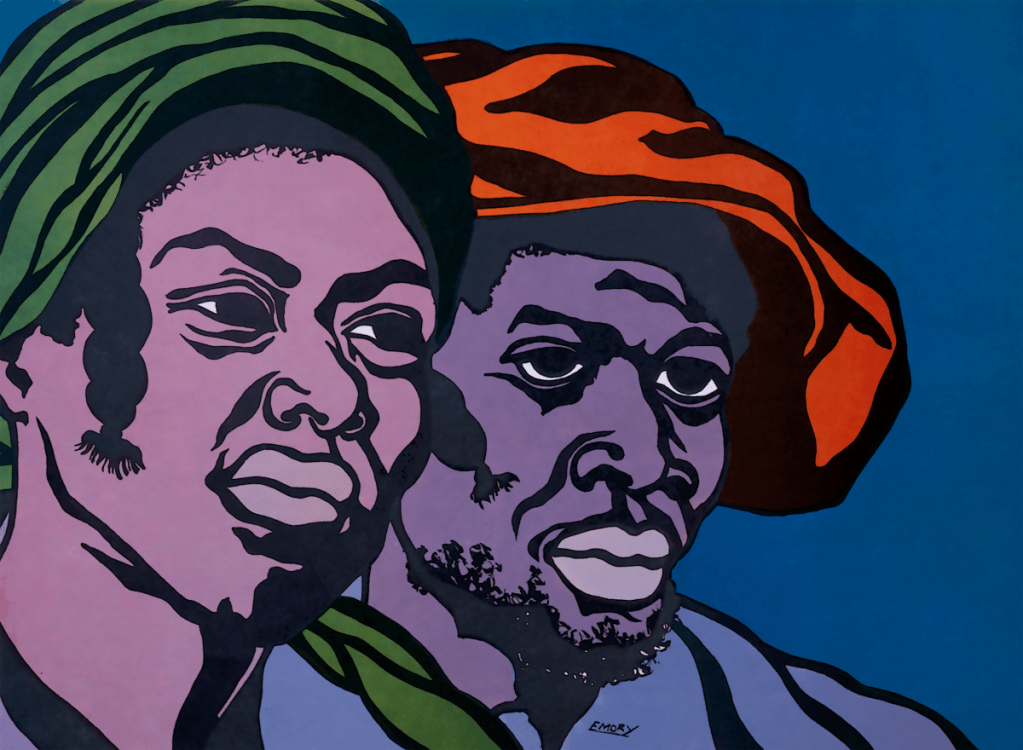
In the landscape of revolutionary visual culture, few figures loom as large as Emory Douglas, the graphic artist and Minister of Culture for the Black Panther Party. Douglas’s work is not just art; it is activism, a visual language that denounces systemic oppression, racial violence, and economic inequality while celebrating community resilience and collective power.
During my research on political art and community engagement, I had the unique privilege of meeting Douglas at SESC Pinheiros in São Paulo. Experiencing his presence firsthand was transformative. Listening to his stories, witnessing the depth of his reflections, and seeing the profound intentionality behind each image brought a tangible dimension to the academic frameworks I had been exploring. It was a rare convergence of theory and lived history.
Douglas’s illustrations, often bold in contrast and stark in their narrative clarity, exemplify how art can operate simultaneously as documentation, agitation, and inspiration. The Black Panther newspaper, for which he designed most of the graphics, became more than a publication—it was a rallying point, a medium through which marginalized voices could speak with authority and urgency.
Meeting him underscored a key insight of my research: that the power of urban and political engagement is inseparable from the ways in which visual culture mobilizes communities, fosters identity, and preserves memory. In an era where struggles for social justice continue worldwide, Douglas’s legacy remains a guiding force, demonstrating how art can catalyze awareness and action.
 Rupture Magazine
Leave a comment