
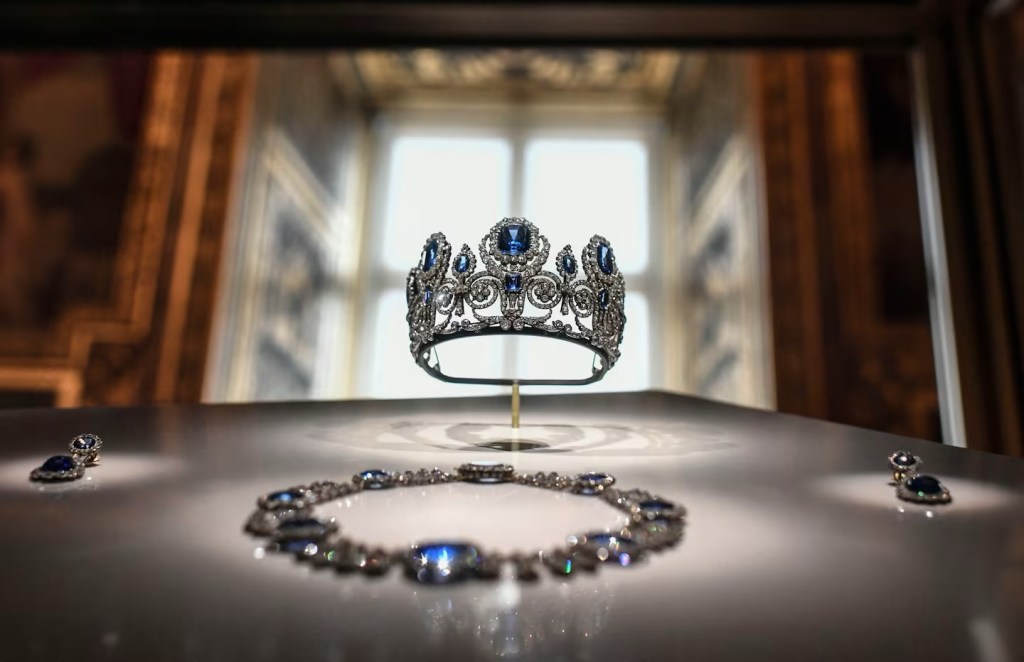
A set of jewelry worn by Queen Marie-Amélie and Queen Hortense is displayed at the Louvre’s Apollo Gallery on Jan. 14, 2020. (Stephane de Sakutin/AFP/Getty Images via CNN Newsource)
Last Sunday’s theft at the Louvre — eight royal jewels vanishing into the Paris night — has been called a crime against culture. But perhaps it exposes something more structural: the long history of how culture itself has been stolen, classified, and sealed behind glass.
When I visited Athens, I heard the same refrain: “We must protect our heritage.” They were building a new museum, a temple of preservation. Yet I couldn’t ignore the paradox — when something is called world heritage, it begins to belong to everyone, and yet to no one. It becomes vulnerable to being moved, displayed, or claimed by someone else in the name of protection.
I felt this same unease again in New Zealand, standing before an Egyptian mummy — a displaced body, translated into a universal object. These moments reveal the strange continuity of heritage practices: the rhetoric of preservation masking an older logic of control. I could give many more examples.
As Dr Emiline Smith, lecturer in criminology at the University of Glasgow, writes in her reflection on the Louvre heist:
“We need a more pragmatic, realistic approach to museum ownership and collection retention. In an age when empires are being re-examined and calls for repatriation are growing louder, not every cultural object can, or should, remain behind glass.”
Her words trace a deep moral fracture — between protection and possession. The Louvre jewels survived revolutions, but not this new era of re-evaluation. Perhaps the heist is less an anomaly than a mirror, reflecting the longer, quieter thefts that built so many collections in the first place.
Museums tell us they preserve the world’s memory. But maybe it’s time to ask: whose memory, and at what cost?
 Rupture Magazine
Leave a comment