
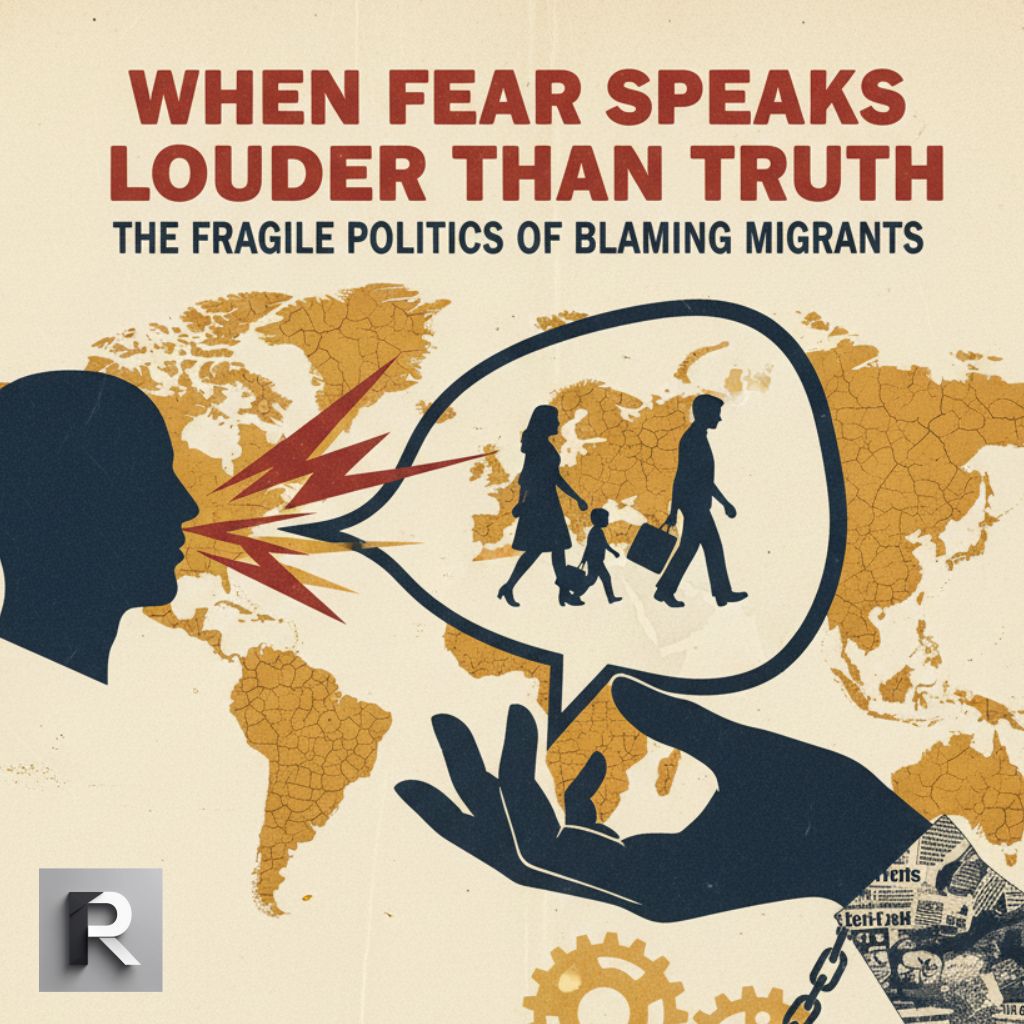
In moments of economic tension, societies often search for simple answers to complex problems. Recently, in Aotearoa New Zealand, the Minister of Immigration warned employers against “choosing migrants over New Zealanders.” It sounded like common sense to some, but such rhetoric hides deeper social and political dynamics. When we look closer, we see not a defence of local workers — but a political strategy that risks fracturing communities, fuelling fear, and weakening the very economy it claims to protect.
The Global Pattern of Fear
Across the world, similar speeches have gained ground. In the United Kingdom, “British jobs for British workers” became a rallying cry before Brexit, triggering labour shortages across health, logistics, and agriculture. In the United States, migrant scapegoating rose sharply during and after the Trump administration, despite studies showing migrants contribute billions in taxes and drive economic innovation. Australia, too, cycles through the same narrative: “protecting local jobs,” while quietly relying on temporary migrants to keep industries like aged care, farming, and hospitality alive.
The pattern is clear. When governments face pressure — inflation, unemployment, or public discontent — blaming migrants becomes a convenient distraction. It diverts attention from structural failures such as stagnant wages, underinvestment in education and vocational training, or the erosion of labour protections.
Why Politicians Use Division as a Tool
Sociological and political research shows that fear and division are powerful tools for control. By framing an external group — in this case, migrants — as the source of internal problems, leaders can consolidate support among voters who feel anxious or left behind.
Political scientists like Pippa Norris (Harvard University) and Ronald Inglehart (University of Michigan) have demonstrated how “cultural backlash” politics thrives in times of rapid change: when social values evolve faster than people’s sense of security. In these conditions, nationalist rhetoric acts as a psychological anchor, giving people the illusion of stability and moral clarity.
But the stability is false. Dividing society between “us” and “them” doesn’t solve unemployment or low wages — it merely obscures the real economic structures at play.
Economic Reality: What the Numbers Say
In New Zealand, migrants make up over 20% of the workforce and are essential to critical sectors.
In healthcare, one in three doctors and one in four nurses are migrants.
In construction, nearly 30% of the workforce comes from overseas.
The horticulture and hospitality industries depend on seasonal and migrant labour, with some regions reporting that up to 50% of staff are migrants.
Without this workforce, New Zealand’s GDP would shrink significantly. The OECD and the New Zealand Treasury have repeatedly shown that immigration is a net economic benefit, helping offset the challenges of an ageing population and declining birth rates.
When countries like the UK or Japan restricted migration, they experienced not only labour shortages but declining productivity and stalled economic growth.
The Social Cost of Fear-Based Politics
Yet beyond economics, the deeper damage lies in social cohesion. Blaming migrants legitimises prejudice and amplifies mistrust between communities. It allows xenophobia — often latent — to become socially acceptable speech. As the Christchurch mosque attacks reminded the world, words have consequences. Fear-based narratives can move from political slogans to real-world violence.
Furthermore, the “divide and control” mechanism benefits political elites. When working people are encouraged to compete with one another — local versus migrant, native versus foreigner — they are less likely to unite in demanding fair pay, better working conditions, or systemic reform. It fragments solidarity, which is precisely what those in power rely on to maintain control.
A Call for Reflection
This is not just a New Zealand issue — it is a global one. The same rhetoric that spreads distrust and resentment here echoes across borders, from Hungary, Portugal to the United States.
Every time we hear a politician pit one group against another, we must ask: Who benefits from this division? and Who loses when we believe it?
Because the truth is simple: societies grow stronger through inclusion, not exclusion. Diversity drives innovation, empathy, and resilience. Fear only limits us.
You’re right — that kind of political speech can deepen social and economic tensions rather than address them.
By framing migrants as the “problem” or as competitors for jobs, it diverts attention from systemic issues like low wages, underinvestment in training, or weak labour protections. Migrants often fill roles locals don’t take because of poor conditions or pay — not because they “take” jobs.
This rhetoric also risks fueling xenophobia and ignoring how migration sustains many essential sectors — healthcare, hospitality, construction, agriculture — especially in a country like Aotearoa New Zealand with an ageing population and workforce shortages.
Bibliography
Aotearoa New Zealand / Governmental Sources
- Ministry of Business, Innovation and Employment (MBIE). (2023). Migration Trends and Outlook 2022–2023. Wellington: New Zealand Government.
- New Zealand Treasury. (2022). Long-term Fiscal Statement: He Tirohanga Mokopuna 2021. Wellington: New Zealand Government.
- Statistics New Zealand (Stats NZ). (2023). Labour Market Statistics: March 2023 Quarter. Wellington: Stats NZ.
- Department of Internal Affairs. (2022). Population Projections and Workforce Trends. Wellington: DIA.
International & Economic Research
- Organisation for Economic Co-operation and Development (OECD). (2023). International Migration Outlook 2023. Paris: OECD Publishing.
- International Labour Organization (ILO). (2022). World Employment and Social Outlook: Trends 2022. Geneva: ILO.
- World Bank. (2022). Migration and Development Brief 37. Washington, DC: World Bank.
- United Nations Department of Economic and Social Affairs (UNDESA). (2022). World Population Prospects 2022. New York: United Nations.
Academic and Political Analysis
- Norris, P., & Inglehart, R. (2019). Cultural Backlash: Trump, Brexit, and Authoritarian Populism. Cambridge University Press.
- Mudde, C. (2019). The Far Right Today. Polity Press.
- Wodak, R. (2020). The Politics of Fear: The Shameless Normalization of Far-Right Discourse. SAGE Publications.
- Goodhart, D. (2017). The Road to Somewhere: The Populist Revolt and the Future of Politics. Penguin Books.
- Castles, S., de Haas, H., & Miller, M. J. (2020). The Age of Migration: International Population Movements in the Modern World (6th ed.). Palgrave Macmillan.
- Massey, D. S. et al. (1998). Worlds in Motion: Understanding International Migration at the End of the Millennium. Oxford University Press.
Comparative and Social Impact Studies
- Dustmann, C., & Frattini, T. (2014). The Fiscal Effects of Immigration to the UK. The Economic Journal, 124(580), F593–F643.
- Migration Policy Institute (MPI). (2023). Labour Market Integration of Migrants in OECD Countries. Washington, DC: MPI.
- Pew Research Center. (2020). Attitudes Toward Immigrants, Asylum Seekers, and Refugees Across Global Economies. Washington, DC: Pew.
- Betts, A., & Collier, P. (2017). Refuge: Transforming a Broken Refugee System. Penguin Random House.
 Rupture Magazine
Leave a comment