

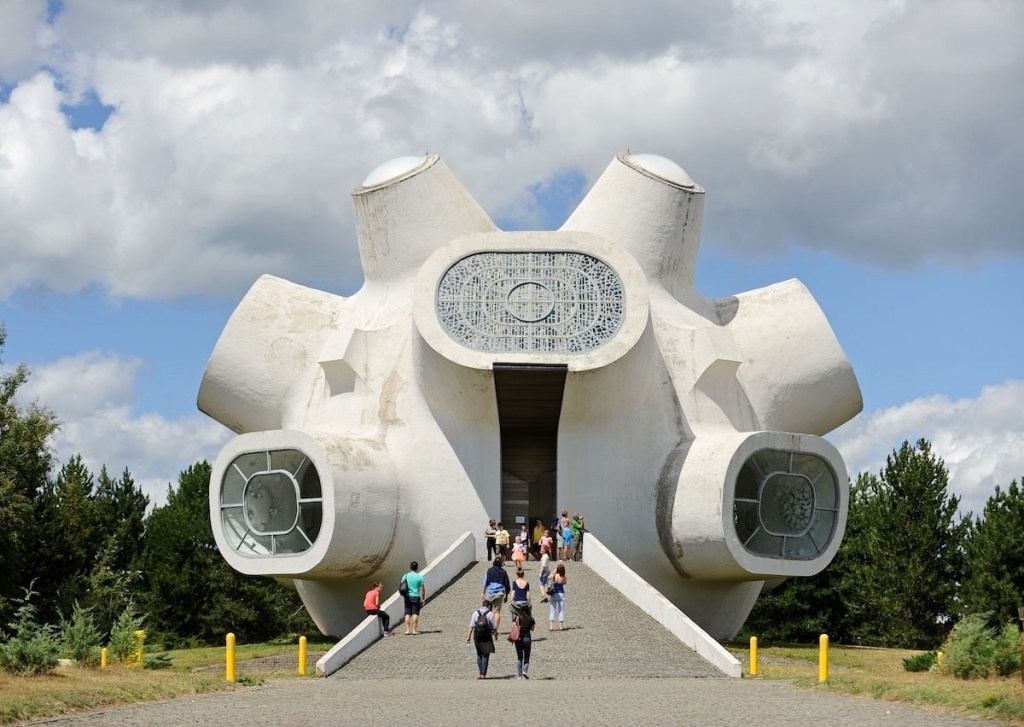

Soviet architecture is often flattened into a single aesthetic stereotype, but serious research shows it was never one coherent style. Instead, it unfolded as a sequence of ruptures — ideological breaks, economic pressures, technological experiments, and cultural reorientations that reshaped the built environment over seven decades. To look at Soviet architecture today is to read a palimpsest of competing futures.
The early post-revolutionary period produced one of the 20th century’s most influential architectural experiments: Constructivism. Scholars such as Selim Khan-Magomedov and Catherine Cooke show how architects of the 1920s attempted to merge industrial logic, social programs, and new forms of collective life. Workers’ clubs, communal houses, and experimental housing prototypes embodied the belief that space could shape the “new Soviet person.” Much of this remained unfinished or theoretical, but the ideas permanently transformed global modernism.
This avant-garde rupture was abruptly reversed in the early 1930s, when Stalin consolidated control. Research by Katerina Clark and Vladimir Paperny highlights how architectural culture was realigned toward monumental, historicizing aesthetics meant to communicate stability, hierarchy, and state power. The monumental skyscrapers, heavy ornamentation, and neoclassical façades of this era were not stylistic choices—they were political instruments. Architecture became a tool to stage the myth of Socialist progress.
The Khrushchev era represented another decisive break. Facing an acute housing crisis, the state abandoned Stalinist monumentality for radical standardization and prefabrication. Architectural historians like Sonia Hirt and Kim Dovey argue that the resulting mass-housing projects (khrushchyovki) were less about aesthetics and more about industrial logic: thin panels, repetitive grids, rapid assembly. These spaces defined everyday life for millions, shaping domestic routines, gendered spatial practices, and the very texture of Soviet urbanism.
Late Soviet modernism (1960s–1980s) adds yet another layer. Recent scholarship documents how architects negotiated between central directives, material scarcity, and local identities. Brutalist civic centers, cultural palaces, sanatoria, and regional hybrids reveal a surprisingly diverse landscape. Rather than decline, this was a period of experimentation shaped by new technologies, Cold War cultural exchange, and the growing autonomy of local design institutes.
Across these decades, what emerges is not a linear narrative but a field of ideological, material, and cultural tension. Soviet architecture embodies rupture as a method: a constant oscillation between ambition and constraint, collectivism and individuality, experimentation and control. Today, these structures occupy an ambiguous place — simultaneously historical documents, cultural memory, and contested heritage.
For Rupture Magazine, this material is fertile ground. Soviet architecture contains the visual and conceptual fractures the magazine is drawn to: unfinished utopias, state-driven aesthetics, everyday infrastructures of survival, and the concrete traces of a political century. These buildings force us to confront how ideology becomes material, how form becomes governance, and how cities absorb the shockwaves of history.
To study Soviet architecture is to examine the architecture of rupture itself — a built environment shaped not by continuity, but by the repeated breaking and remaking of its own foundations.
 Rupture Magazine
Leave a comment