
Photos by Carolina Nery

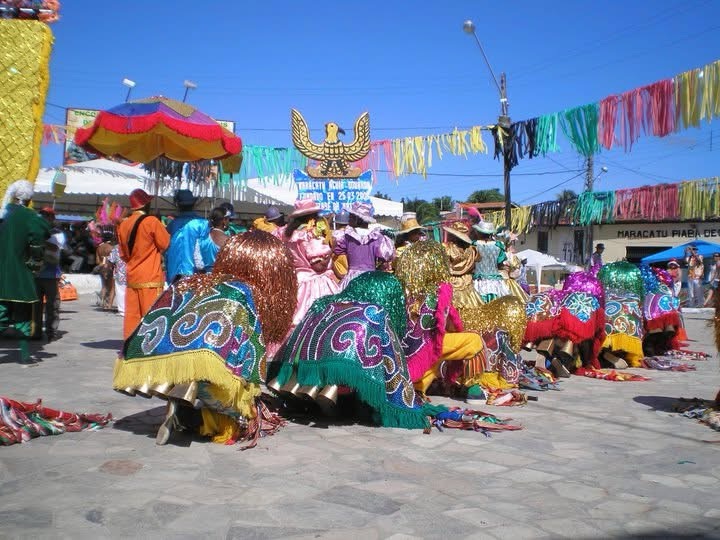

On a recent secret road trip into the heart of Pernambuco’s Zona da Mata, guided by a friend from the region who knows these rhythms in his bones, we had the rare pleasure of watching Maracatu Rural in action during CarnAval in Recife, not as tourists, but as witnesses to something deeply rooted and politically resonant.
Maracatu Rural, also known as maracatu de baque solto (loose baque), is a cultural expression that combines music, dance, poetry, ritual and cosmology. It originated in the rural sugar-cane belt of the Zona da Mata Norte of Pernambuco, especially around towns like Nazaré da Mata and neighbouring communities, in the late 19th and early 20th centuries among rural workers, particularly those tied to the cane fields and engenhos (sugar estates).
This tradition is not a simple CarnAval spectacle, but a complex, living archive of memory and resistance. Its participants, known as folgazões, are often descendants of Afro-indigenous and working-class communities whose ancestors lived within systems of plantation labour, religiosity, and interlocking cultural worlds. Maracatu Rural is part of a broader maracatu universe, but distinct from the more urban maracatu nação, both in rhythm and social meaning.
At the centre of Maracatu Rural is the Caboclo de Lança, an imposing figure with elaborately decked costumes, bells, mirrors and his signature lance. Far from a costume in the carnival sense, this character embodies spiritual protection, collective memory and bodily resistance that is both aesthetic and existential.
The music and procession unfold differently from the urban maracatu of Recife and Olinda: the rhythms are shaped by baque solto patterns, incorporating percussion, brass and wind elements, and the movement itself feels woven from the lived experience of rural life. The lyrics, rhythms and improvisations (sambadas) are not just entertainment but a form of social commentary and oral archive, often negotiated in verse battles that carry centuries of nuanced cultural intelligence.
The tradition survives not because it is static, but because it continues to be reshaped by the people who carry it, negotiating identity, territory and memory between generations. In recent years, this expression was officially recognised as Brazilian Intangible Cultural Heritage, reflecting its value not merely as folklore but as a living cultural technology.
Seen in CarnAval processions in Recife, or felt in the rhythms joining street and field, Maracatu Rural is a defiant claim to presence. It refuses to be reduced to nostalgic spectacle; instead it asserts a continuity of life, resistance and collective belonging that reverberates long after the last drumbeat fades.
Selected Bibliography | Maracatu Rural (Baque Solto)
REAL, Katarina. O Folclore no Nordeste. Recife: FUNDAJ / Editora Massangana, 1990. → Foundational ethnographic research on Maracatu Rural and popular traditions in Pernambuco.
IPHAN – Instituto do Patrimônio Histórico e Artístico Nacional. Dossiê do Maracatu de Baque Solto (Maracatu Rural). Brasília / Recife, 2014. → Official recognition document for Maracatu Rural as Brazilian Intangible Cultural Heritage.
BORBA FILHO, Hermilo. Espetáculos Populares do Nordeste. Rio de Janeiro: MEC / FUNARTE, 1977. → Classic study on popular performance, ritual, and carnival traditions.
GUERRA-PEIXE, César. Maracatus do Recife. Rio de Janeiro: Irmãos Vitale, 1980. → Musical and structural analysis of maracatu rhythms and forms.
SANDRONI, Carlos. Feitiço Decente: Transformações do Samba no Rio de Janeiro (1917–1933). Rio de Janeiro: Zahar, 2001. → Broader Afro-Brazilian cultural framework, useful for contextual comparison.
 Rupture Magazine
Leave a comment